Model Schema
Schema: model
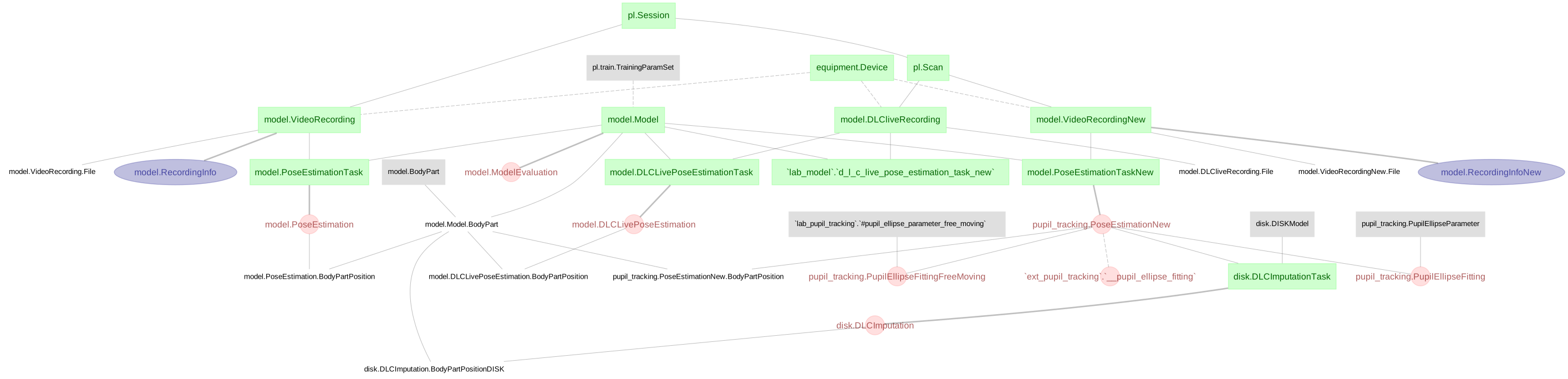
This schema manages video recordings, model definitions, and pose-estimation outputs. It is the main route from camera streams to body-part trajectories.
What this schema answers
Which recording/model pair produced a pose estimate?
Which task is staged (
load/trigger) and where is output stored?Which body-part trajectories are available for alignment with events or neural data?
Core tables used most often
model.VideoRecording,model.VideoRecording.Filemodel.VideoRecordingNew,model.VideoRecordingNew.Filemodel.Model,model.Model.BodyPartmodel.PoseEstimationTask,model.PoseEstimationmodel.PoseEstimationTaskNewmodel.RecordingInfo,model.RecordingInfoNew
Query anchors
recording_idmodel_nametask_mode
(model.PoseEstimationTaskNew & {'scan_id': 'scanXXXXXXXX'})
(model.PoseEstimationNew & {'recording_id': 'LE_eye_left_tracking_YYYY-MM-DD'})
Diagram
Notes for users
Keep
recording_idandmodel_nameexplicit in all notebook outputs.Validate
task_modebefore interpreting empty computed tables.Use model body-part vocabularies as controlled contracts across analyses.
Element lineage
ADAMACS model tables build on Element DeepLabCut patterns. Reference: https://docs.datajoint.com/elements/element-deeplabcut/latest/
External references
DataJoint query operators: https://docs.datajoint.com/core/datajoint-python/latest/query/operators/
Element DeepLabCut: https://docs.datajoint.com/elements/element-deeplabcut/latest/
DeepLabCut docs: https://deeplabcut.github.io/DeepLabCut/
DeepLabCut source: https://github.com/DeepLabCut/DeepLabCut